Showing posts with label astronomy. Show all posts

Monday, 17 March 2014

First Direct Evidence of Cosmic Inflation

Swirls in the CMB polarization, shown here in the BICEP2 data, show the first clear evidence of primordial gravitational waves. Image: BICEP2

The title of the scientific presentation said it all:

"First Direct Evidence of Cosmic Inflation".

It appears that the rumours were true and BICEP2 has discovered something extraordinary.

The full set of scientific papers is online here: http://bicepkeck.org/
The FAQ summarising the data is here: http://bicepkeck.org/faq.html

Adam Mann reports:
"A team of scientists may have detected a twist in light from the early universe that could help explain how the universe began. Such a finding has been compared in significance to the detection of the Higgs boson at the LHC in 2012. What they detected is known as primordial B-mode polarization and is important for at least two reasons. It would be is the first detection of gravitational waves, which are predicted to exist under Einstein’s theory of relativity but have never before been seen. But the thing that has scientists really excited is that it could provide the first direct evidence for a theorized event called inflation that caused the universe to exponentially grow just a fraction of a fraction of a second after it was born."

“Detecting this signal is one of the most important goals in cosmology today.” noted astronomer, John Kovac, of Harvard, who led the team announcing the discovery.

Dr Jo Dunkley who has been searching through data from the European Planck space telescope for a B-mode signal, stated: "I can't tell you how exciting this is."

"Everything that is important, everything we see today - the galaxies, the stars, the planets - was imprinted at that moment, in less than a trillionth of a second. If this is confirmed, it's huge."

Alan Guth himself -one of the fathers of the theory of inflation - was cautiously optimistic about the initial announcement:
"No experiment should be taken too seriously until there's more than one that can vouch for it. But it does seem to me that this is a very reliable group and what they've seen is very definitive."

Later in the New York Times, Guth pronounced himself “bowled over,” saying he had not expected such a definite confirmation in his lifetime. “With nature, you have to be lucky,” he said. “Apparently we have been lucky.”

And here is the news being broken to theorist, Andrei Linde, another of key authors of the inflationary universe theory (as well as the theory of eternal inflation):


Max Tegmark, a cosmologist at MIT, told the New York Times, “I think that if this stays true, it will go down as one of the greatest discoveries in the history of science.” He added, “It’s a sensational breakthrough involving not only our cosmic origins, but also the nature of space.”

Nobel Prize winner, Frank Wilczek, commented: "Assuming the BICEP results are what they appear to be, it will be, like the Higgs particle: a triumph for boldness and minimalism."

This announcement has implications far beyond the field of cosmology.  If the detection is confirmed, and inflation theory is eventually accepted, particle physicists will also be intrigued.  According to inflation theory, a quantised particle called the inflaton exists, and is hypothesized to be responsible for cosmic inflation in the very early universe.  So as physicist Richard Easther, points out, "we're not just looking at the beginning of the universe, we are exploring undiscovered vistas in particle physics."

The BICEP - (Background Imaging of Cosmic Extragalactic Polarization) telescope, Antarctica

Meanwhile, one of the hottest debates in the coming days and weeks is what these results mean for cosmological models which involve the existence of the Multiverse.  Even before the press conference was finished, early comments were being made.

Sean Carroll remarked:
"I'm less sure than Guth & Linde on the inflation -> multiverse connection. But inflation certainly strengthens the case for a multiverse."

Whatever way you look at it, today has been a truly historic day for physics, and has ushered in a new era of scientific enquiry.  The days, weeks and months ahead promise to be captivating, as physicists strive to comprehend the significance of these new findings.

Initial media reactions:
http://www.wired.com/
http://www.bbc.com/
http://www.newscientist.com
http://www.nytimes.com

Primordial Gravitational Waves and Cosmic Inflation


Today might turn out to be a historic day for the field of cosmology.  At 16:00 UTC at the at Harvard-Smithsonian Center for Astrophysics, physicists will be announcing what they are describing as a "major discovery".

Since the news of the announcement broke last week, the cosmology community has been awash with rumours as to what the discovery might be.

Most cosmologists now believe the announcement will concern the detection of gravitational waves in the polarization of the cosmic microwave background radiation, by an experiment called BICEP2, based near the South Pole in Antarctica.

If this is the case, it has wide-ranging implications for our understanding of the early universe.  Detection of these primordial gravitational waves would be the best evidence yet that cosmic inflation occurred, shortly after the Big Bang.  It would strongly support the theory of inflation, posited by Alan Guth, Andrei Linde and others, and developed by a generation of theoretical cosmologists.

Until 1600 UTC today, we won't know for sure, but it is clear that the cosmology community believe the announcement will be highly significant. If evidence for gravitational waves is presented, it would be a pioneering discovery that would change the face of cosmology.

As noted physicist, Sean Carroll, writes:
"Other than finding life on other planets or directly detecting dark matter, I can't think of any other plausible near-term astrophysical discovery more important than this one for improving our understanding of the universe. It would be the biggest thing since dark energy."

Rumours began circulating shortly after a press release was issued last Wednesday. Cosmologist Richard Easther, of the University of Auckland, was amongst the first to pick up on the story, shortly followed by fellow New Zealander, Shaun Hotchkiss, who has been keeping an constantly updated list of posts and background reading material on his Trenches of Discovery blog.  The rumours centre on the supposed detection of "B-modes" at microwave lengths in the cosmic microwave background (CMB).  B-modes have been sought by physicists for years, as they are thought to be the best evidence that a period of inflation occurred immediately after the Big Bang.  If detected, as Phillip Gibbs at viXra notes, "this would be a very big deal indeed because it could be a direct experimental hook into the physics of inflation and even quantum gravity. These are of course the least well understood and most exciting unchartered waters of fundamental physics. Any observation that could provide phenomenology for these areas would be the greatest empirical discovery for the foundations of our universe for decades."

But he urges caution about assessing the implications of the announcement, stressing that, "the new result ... will be scrutinised, not least by rival astronomers from the SPT and Polarbear observatories who only managed to detect lensing B-modes. Why would BICEP2 succeed where they failed? Can they be sure that they correctly subtracted the background? These questions are premature and even immature before we hear the announcement, but it is good to go along prepared for the kind of questions that may need to be asked."

BICEP - (Background Imaging of Cosmic Extragalactic Polarization), Antartica

If the rumours are true, the announcement has major significance for the theory of cosmic inflation. As Hotchkiss writes:
"Inflation is a compelling theory, not without some problems, for how the universe evolved in its very earliest stages. If it occurred when the universe had a large enough temperature, it would generate primordial gravitational waves large enough to tickle the CMB enough to make these B-modes visible in the polarisation."

Hiranya Peiris, a cosmologist from University College London emphasises the point by noting:
"The primordial gravitational waves have long been thought to be the smoking gun of inflation. It's as close to a proof of that theory as you are going to get."

Cosmologists believe that only inflation would amplify the primordial gravitational waves into a detectable signal. If BICEP2 has found such a signal, this will be a very big day indeed.

Tuesday, 31 December 2013

There, but invisible

Swell by Anthony McCall. Commissioned by AV Festival 2006.

In physics, the darkness is the most illuminating place to look, if you want to understand the Universe right now. This year, Planck told us that 26.8% of all matter is dark. Thanks to the earlier work of Brian Schmidt, Saul Perlmutter and Eric Riess, cosmologists also have to deal with the fact that the Universe is expanding at an ever increasing rate, and that the energy responsible for that - dark energy - accounts for 68.3% of all energy.

So we now know that nearly 96% of the Universe is dark. It is there; but invisible.

But what this means is that we live in some of the most exciting times imaginable.
Because we live in a Universe that is to a large extent unknown to science, and therefore the systems that govern all but 4% of the Universe are yet to be discovered.

"And, everything is possible again."

I'll be taking that thought into 2014.

Honor Harger
31 December 2013

Sunday, 6 October 2013

Kepler conference in need of a new home


This week a scandal rocked the astronomy community, relating to a exo-planet conference which will discuss results from the Kepler Space Telescope. The Kepler Science Conference II is scheduled to take place at NASA Ames' research facility next month.

However, US government laws have made it impossible for the organisers to welcome colleagues from countries such as China to the conference.  As Ian Sample reported this week, all Chinese nationals are prohibited from setting foot on NASA property by law.  Consequently, the conference has had to exclude scientists from China, as well as scientists from nations such as, Burma, Eritrea, Iran, North Korea, Saudi Arabia, Sudan and Uzbekistan, from the event. This has sparked major controversy, and a campaign to boycott the event.

As Tim Cross noted in the Economist, "it is hard to fathom what secrets any supposed Chinese spies would have been able to pilfer at a conference devoted to alien planets."

A group of scientists are now trying to arrange an alternative venue for the conference so that any scientist registered to attend - no matter what nationality they are - is able to share their research with their colleagues. Lucianne Walkowicz, a scientist who worked on the Kepler mission, has called for help to find an alternative space for the conference.

The very principles of open science are at stake here.  As astronomer, Chris Lintott, has said:

"I'm shocked and upset by the way this policy has been applied. Science is supposed to be open to all and restricting those who can attend by nationality goes against years of practice, going right back to cold war conferences of Russian and western physicists."

Geoff Marcy, known for discovering more extrasolar planets than anyone else, and tipped as a future Nobelist, has put it more strongly calling the exclusion of scientists from the banned nations, "completely shameful and unethical." He said:

"In good conscience, I cannot attend a meeting that discriminates in this way. The meeting is about planets located trillions of miles away, with no national security implications."

Those of us with good networks and contacts may be able to help.

Finding a venue that can accommodate 400 people, between November 4-8, 2013, in the Bay Area in California is going to be very challenging, but surely not impossible.  If you are aware of venues that can accommodate up to 400 people, please reach out to Lucianne and let her know.  There are many obstacles that would need to be addressed before the conference could be shifted, but locating some possible alternatives spaces is the first step.

Thursday, 18 April 2013

Dark matter remains dark - for now

CDMS detector. Courtesy of Fermilab.

For the past month and a bit, the biggest story in physics has undoubtedly been dark matter.

When Sam Ting, the charismatic Nobel Prize winning director of the AMS project, announced in February that the team who monitor his orbiting Alpha Magnetic Spectrometer, latched to the ISS, would be announcing 'significant results' in the search for dark matter, the whole physics community held its breath.  Somewhat skeptically.
The results, when they were announced on 30 March at CERN, seemed to add weight to the measurements made by PAMELA, in 2008, and were certainly of significant interest.

AMS-02 on ISS. Courtesy of CERN
But they perhaps fell short of what many were hoping for. As theoretical physicist, Katie Mack put it on 5 April in Physics Focus - somewhat bluntly, it should be said, "the AMS-02 detector on the International Space Station has not detected dark matter. It hasn't found 'indications' of dark matter, or even 'hints'. It certainly is not providing the 'best evidence yet' of dark matter's existence."

She did, however, acknowledge the important measurements the AMS-02 detector has made:
"What AMS has done is measure, to very high accuracy, the amount of antimatter the galaxy is bombarding us with. [....]. The AMS experiment detects cosmic rays - protons, electrons, and the antimatter counterparts of each, antiprotons and positrons. Before the experiment ran, we had predictions of how the matter/antimatter fraction should vary with the energy of the particles. AMS tells us our predictions were wrong. The antiprotons look about right, but there's a huge excess of high-energy positrons over what astrophysical models predict, and a bump in the electron flux at high energies. All of these results were actually seen by earlier experiments PAMELA and Fermi, but AMS confirms them to higher precision and higher energies. There's more antimatter than we thought; now we have to figure out why."

This is a concise explanation of the so-called 'positron-excess', which is one of the key indicators that dark matter - whatever it is - exists.  Mack goes on to explain, that the radio astronomers' favourite phenomenon, pulsars, are thought by many astrophysicists to be the cause of the positron excess.
"Pulsars [...] can use their extreme magnetic fields to accelerate particles and create electron-positron pairs. The fact that pulsars do this is solidly in the realm of known physics, and theoretical models can easily fit the signals seen in the cosmic ray experiments."

This is far from an accepted theory of the origin of dark matter, but it is a fascinating one nonetheless.  But where else might we look to find out about the origins of dark matter? The answer is: the mines.

Far beneath the surface of the earth, some of the most significant searches for dark matter have been underway for years. This week, one of the most notable of these, the CDMS experiment (the Cryogenic Dark Matter Search) in the Soudan mine in Minnesota, posted some extremely interesting results. Graduate student, Kevin McCarthy, reported at the American Physical Society meeting in Denver on 13 April that CDMS has found "three promising clues" of dark matter. The their silicon detectors had picked up possible signs of three weakly interacting massive particles (or 'WIMPs', as physicists call them).  Their evidence is verifiable to a level of three-sigma.

As Jason Palmer explains, particle physics has an accepted definition for a "discovery": a five-sigma level of certainty. "The number of standard deviations, or sigmas, is a measure of how unlikely it is that an experimental result is simply down to chance, in the absence of a real effect Similarly, tossing a coin and getting a number of heads in a row may just be chance, rather than a sign of a "loaded" coin The "three sigma" level represents about the same likelihood of tossing nine heads in a row. Five sigma, on the other hand, would correspond to tossing more than 21 in a row. With independent confirmation by other experiments, five-sigma findings become accepted discoveries."

So CDMS' three-sigma result falls short of this, but it most certainly counts as a 'tantalising hint'.

As science writer Valerie Jamieson notes, the CDMS dark matter signal fits with recent theories that suggest dark matter is, "not a single entity, but a 'dark sector of particles' that could include dark antimatter".

"This may be the start of a very big deal" observes dark matter theorist Dan Hooper, of Fermilab, who manage CDMS.

So whilst dark matter remains enigmatic, and most certainly dark, for now, there's some hope we may be closing in on its secrets.

Sources:


Monday, 25 February 2013

Ensonifying space


It is very heartening and interesting to read so many fascinating articles, emerging from my Tuning into the Universe piece for Huffington Post this weekend.

Scientists and journalists from Huffington Post community have published a range of pieces on everything from data sonification, to astereoseismology, to the reminiscences of a former astronaut. Together these articles greatly expand the field of general knowledge around the physics of radio astronomy, and our capacity to sensorially experience it.

One of the pieces draws on an interview with radio astronomer, and the co-founder of the SETI Institute, Jill Tarter. Amplifying the central message of  Tuning into the Universe, Tarter notes that:
"when SETI listens to the cosmos, the institute is actually receiving electromagnetic radiation. And then, just the way your radio does, that energy can be used to make audible sound."

The pieces published in response to the article extend, expand and ensonify this notion.  Some of my favourites include:

The Sound of the Deep Sea of Space by radio astronomer, Dr. Tyler Nordgren equates the universe with a vast ocean, echoing Carl Sagan's famous analogy from his series, Cosmos. He poetically maps out the methods of astronomical observation available to modern astronomers, beyond the detection of visible light. He notes: "as a young radio astronomer I learned early on that every time human beings have explored the world with new senses we have discovered new and amazing phenomena".

Voices Carry by Anna Leahy and Douglas Dechow explores the sonic signature of our own planet:
"The sound of the Earth's inherent dynamics -- the movement of atmosphere and oceans -- produces a steady drone as well. Lightning produces crackling, which scientists call sferics."

Voyager Golden Record
The article includes a memorable passage about the Voyager Golden Record, which contains 'greetings in 56 languages, natural sounds like thunder and crickets chirping, and music from around the world', encoded in audio and now travelling towards the outer reaches of our solar system on board Voyager.

In An Audible Tour of the Solar System? Sign Me Up!, astronomer and planetary scientist, Jim Bell analyses our celestial neighbourhood, exploring the potential for acoustic sound on each of our nearest planets. The Perfect Quiet of Space by legendary astronaut, Jerry L. Ross, is the extraordinary account of his nine spacewalks, undertaken during his seven missions into space.

Jerry L. Ross n one of his nine spacewalks.

He writes eloquently about the silence which astronauts experience, when outside the International Space Station:
"Without the sophisticated listening devices scientists use on earth to hear the whispers of the universe, to an astronaut space is infinite quiet, a place where we bring the only sounds that break the silence."

Sound: The Music of the Universe by Mark Ballora and George Smoot III is an excellent overview of the practice of data sonification, which takes in in the brilliant work of the xSonify team, who are making sonification applications for blind scientists. The article also refers to the emerging science of astereoseismology and exoseismology, which I talked about last Friday in my Sonic Acts talk.

They clearly explain why data sonification methods can be useful:
"Symbolic renderings create other perspectives. Literal renderings are not always compatible with the capabilities of our auditory system. When data points are treated as audio samples and played back at audio rates (typically at 44100 values/second) quick changes are lost to us, as we can't hear fluctuations discretely at the millisecond level. If, instead, we treat the data points symbolically, for example as pitches, we are better able to "magnify" what we are listening to."

In Understanding the Sound of Space, Ayodele Faiyetole notes that sound is under used in science.  He draws on an interview with cosmologist, Yuko Takahashi, who believes there's a great value in presenting scientific results in a totally different dimensions, such as sound:
"Maps of CMB anisotropy can be converted to sound as a telescope sweeps across the sky to give the audience a better appreciation of the fluctuations."

As Ballora and Smoot put it, "if the universe is, at some level, music, then it seems only natural that we should study it with musical tools of thinking."

Saturday, 23 February 2013

Tuning into the sound of the universe with radio


This weekend, Huffington Post have published my piece, Tuning the Universe, which contextualses my TED talk, which they are featuring as part of TED Weekends.

The piece provides some background into the audified radio waves which I played during my talk. Here's the gist of the article:

"We have been surrounded by stunning portrayals of our own solar system and beyond for generations, in books, on film and on television. But in popular culture, we have no sense of what space sounds like.  And indeed, most people associate space with silence.
There are, of course, perfectly valid scientific reasons for assuming so. Space is a vacuum. Sounds cannot propagate in a vacuum.  But through the intervention of radio, it is possible for us to listen to the Sun's fizzling solar flares, the roaring waves and spitting fire of Jupiter's stormy interactions with its moon Io, pulsars' metronomic beats, or the eerie melodic shimmer of a whistler in the magnetosphere."

My talk, and my work in this area, emerges from the science of radio astronomy.


RT16 at the Ventspils International Radio Astronomy Centre. Latvia
Whilst optical astronomers use telescopes to look at the visible light emitted by stars, radio astronomers use radio telescopes, or antennae, to detect radio waves. By combining radio astronomy with radio and sound engineering, we can hear as well as see the stars, and thus greatly expand our sensory perception of our cosmos.

It is important to remember that stars and planets are not directly audible. The recordings I played in my talk are radio waves which have been converted into sound waves using radio receives and amplifiers.  This is a process I refer to as audification. Huffington Post have also published two companion pieces which respond to the talk, the first of which emphasises this point.  Celestial Sound Effects by Seth Shostak notes correctly that, "they're electromagnetic noise, converted by electronic devices ... into signals that - when played through a loudspeaker - become the atmospheric pressure waves we call sound."

The second piece is What Is the Color of the Universe? by Mario Livio, which uses Karl Glazebrook and Ivan Baldry survey of more than 200,000 galaxies (the 2dF Galaxy Redshift Survey) as a basis for examining the colour of the universe.

Thanks to Huffington Post and Janet Lee at TED for publishing the piece.

And here's the talk in full:

Tuesday, 5 February 2013

New Zealand recognised as major contributor to radio astronomy history

John Bolton (left) and New Zealander Gordan Stanley (centre), pictured with Jow Pawsey
New Zealand has claimed its place in radio astronomy history. As reported here a year ago, New Zealand has significant scientific heritage in the field of radio astronomy, and has begun to explore and celebrate this history.

Last week, some of the biggest names in the field gathered for an international conference which marked New Zealand's role in helping to kick-start radio astronomy research in the 1940s.  Attended by the doyenne of the field, Jocelyn Bell Burnell, and researchers and historians from New Zealand, Australia and the UK, the conference explored the work of John Bolton and New Zealander, Gordon Stanley, who detected radio waves from outside the solar system in August 1948 from sites in Pakiri and Piha in the North Island of New Zealand.


Elizabeth Alexander
The conference also commemorated the pioneering work of Elizabeth Alexander, often referred to as the first female radio astronomer, who helped helped establish some of the early foundations of solar radio astronomy in 1946. Alexander studied sources of interference effecting radar stations in New Zealand established during World War II.  During March-April 1945, solar radio emission was detected at 200 MHz by operators of a Royal New Zealand Air Force radar unit located on Norfolk Island.
The emissions became known as the "Norfolk Island effect". Alexander, then based at the Department of Scientific and Industrial Research in Wellington, heading up the Operational Research Section of the Radio Development Laboratory, carried out the most significant early work on the effect throughout 1945. In 1946. she published a paper in the journal, Radio & Electronics describing the emissions, and in doing so, furthered the fledgling field of radio astronomy.

Wayne Orchiston, writing in "The New Astronomy", has noted that Alexander's research also led to further solar radio astronomy projects in New Zealand in the immediate post-war year, and in part was responsible for the launch of the radio astronomy program at the CSIRO, in Australia."

Radar Station (Whangaroa) - one of five involved in New Zealand's investigation of solar radio emission. Image courtesy of Wayne Orchiston.
Astronomer Miller Goss, from the National Astronomy Observatory in New Mexico, puts it:
"Bolton and Stanley's discovery revolutionised twentieth century astronomy."

Following their pioneering discoveries, Bolton went on to become a major figure in Australian radio astronomy, helping found the famous Parkes radio telescope, becoming director of the Australian National Radio Astronomy Observatory and winning the the inaugural Jansky Prize in 1966 (so named after the father of radio astronomy, Karl Jansky).

Sergei Gulyaev
 The conference was organised by the extraordinary Sergei Gulyaev, who has revitalised radio astronomy in New Zealand, spearheading the nation's participation in the SKA, amongst many other efforts.

Sunday, 20 January 2013

It's full of stars


This week the noted photographer and optics engineer, Stéphane Guisard posted a stunning mosaic image of the Milky Way captured at ESO's Paranal Observatory in Chile.

The mosaic is constructed from 52 fields, shot over 29 nights, and consists of 1200 separate photos and 1 billion pixels. The image transports us to the centre of the Milky Way, giving us a scalable and zoomable encounter with literally millions of stars.

As Guisard notes, "it shows the region spanning from Sagittarius (with the Milky Way center and M8/M20 area on the left) to Scorpius (with colorful Antares and Rho Ophiuchus region on the right) and Cat Paw nebula (red nebula at the bottom)."

This is the galaxy in extreme fidelity. Enjoy getting lost in the detail.

Source: http://sguisard.astrosurf.com/Pagim/GC.html

Sunday, 14 October 2012

Archaeologists of the Sky


This week I have been spending a lot of time thinking about the artwork of Trevor Paglen, which is currently featuring in an exhibition I co-curated at Lighthouse in Brighton, UK called Geographies of Seeing. Paglen describes his practice as "experimental geography". He is interested in illuminating the "black world" of clandestine military operations carried out in orbit and here on earth.

They Watch the Moon, 2010, C-print © Trevor Paglen

To do so, one writer has noted, "Paglen looks upwards to the night sky, one of the oldest laboratories of rational thought".

This quote prompted Mark Simpkins to note that, "astronomy is archaeology of the sky", something that resonated strongly with me. It prompted me to check in on the progress of the 21st century's grandest sky archaeology project - the Square Kilometre Array, or SKA.

As we reported in April last year, the SKA will be the world's largest and most sensitive radio telescope.  Rather than being a huge single radio dish, it will be made up of thousands of smaller ones, which are distributed across vast geographical areas.

In May this year it was announced that the SKA would be jointly hosted in Southern Africa and Australia and New Zealand, a decision that prompted some controversy, as the two geographical areas had been in direct competition to host the array.  But controversies aside, this month, the SKA took a major step forward with the launch of Australia's ASKAP - or Australian Square Kilometre Array Pathfinder.

Australian Square Kilometre Array Pathfinder (ASKAP). Image courtesy of CSIRO.

ASKAP is located in remote Western Australia, and is operated by the Murchison Radio Astronomy Observatory. It is made up of 36 identical antennas, each 12 metres in diameter, working together as a single instrument, using the technique of interferometry.  As well as being a significant radio telescope in its own right, ASKAP is an important testbed for the SKA .

A new receiver technology called a "phased array feed" means ASKAP will be able scan the sky much more rapidly than existing radio telescopes, prompting claims it is the fastest radio telescope in the world today.
The sky archaeologists at ASKAP are focusing on some of the major fundamental issues within cosmology and astronomy.  ASKAP is expected to make advances in understanding galaxy formation, dark energy the evolution of the Universe. Some of the initial research will include a census of all galaxies within two billion light years. This may shed light on how our own galaxy, the Milky Way, was formed.

Brian Boyle, the director of ASKAP for CSIRO, Australia's national scientific research organisation, explained why radio astronomy is such a powerful tool in the arsenal of modern science:
"Radio waves tell us unique things about the cosmos, about the gas from which stars were formed, and about exotic objects, pulsars and quasars, that really push the boundaries of our knowledge of the physical laws in the universe".


Writer, Rebekah Kebede notes that ASKAP is located in remote Murchison, "an area of 50,000 square kms, or the size of Costa Rica, with barely 120 people."

The location is ideal for radio astronomy because it is "radio quiet" - it lacks man-made radio signals that interfere with antennas designed to detect celestial signals.  The area is the home of the Yamatji Marlpa people, who are the traditional owners of the land on which the observatory is cited.

ASKAP opened on 5 October 2012. Australia will build another 60 antennas for the SKA, which begins construction in 2016.

Huffington Post writer, Alex Cherney has put together a stunning time-lapse video showing ASKAP in motion. The two night-sky images of ASKAP used in this post are from him.


Sources:
http://phys.org/news/2012-10-askap-dish-australian-telescope-array.html
http://www.universetoday.com/97688/36-dish-australian-telescope-array-opens-for-business/
http://www.cosmosmagazine.com/news/6044/worlds-fastest-radio-telescope-starts-australian-outback

Sunday, 7 October 2012

Sea Above, Sky Below


Sea above, sky below.  The phrase is seemingly a contradiction and a mental paradox.  Yet recent research into cosmology, astronomy and oceanography suggests that this riddle is perhaps not as irreconcilable as what it may first appear. Recalling Milton's evocation of the empty heavens as a kind of ocean, the inversion of sea and sky is taking place all around us, in physics and in oceanography.

The most important advances in scientific thought about the origins and structure of the universe now suggest that our world may be just one amongst many, floating in a cosmological sea. The space probe Cassini has revealed that even in the heavens above, oceans may in fact, be commonplace.  Radio astronomers describe the noise storms of Jupiter and its moon Io as sounding like ocean waves breaking up on the beach. And here on the firmament we are increasingly turning to the oceans in order to better understand the skies.

ALMA (the Atacama Large Millimetre/submillimetre Array)

After recently watching the documentary, Seeing Stars, which analyses the new generation of telescopes that enable scientists and engineers to do 'extreme astronomy', I was prompted to revisit some of the unusual techniques which are currently being used to probe the edges of our universe, which I first starting looking into a few years ago.
The documentary, by the way, is well worth watching:


The infant branch of astronomy, known as "neutrino astronomy" is motivated by the possibility of observing phenomena, such as cosmic neutrinos, that are inaccessible to optical telescopes.  Cosmic neutrinos, which are believed to be produced by cosmic rays, are very difficult to detect. By building arrays deep under water, astronomers can make sure that most of the particles they detect are actually produced by cosmic sources. These detectors look down through the Earth to see the universe, using the whole planet as a shield to absorb the riffraff of particles from the atmosphere.


One of the leading voices within oceanic neutrino science is Dr Paschal Coyle (pictured), who is based in Marseille in France.  His 2007 Journal of Physics paper, Neutrinos Out of the (Deep) Blue remains a valuable reference in surveying the various approaches to underwater neutrino observation.

He is a key researcher with the ANTARES observatory, which is situated under the Mediterranean Sea, 42km off the coast of Toulon. His team set out to monitor their below-sea telescope in the brilliantly named research vessel, Pourquoi Pas?.

ANTARES research vessel, Pourquois Pas?

ANTARES stands for "Astronomy with a Neutrino Telescope and Abyss environmental RESeach project", a rather clunkily assembled acronym, but one that figuratively at least, situates one of our most charismatic stars - Antares - deep under the sea.

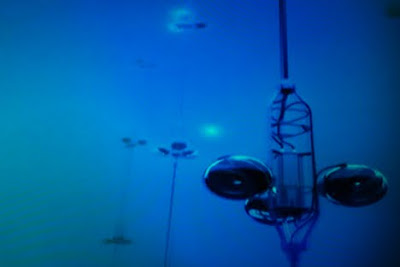
The ANTARES detector comprises a total of 900 optical modules distributed over 12 flexible lines, each comprising 25 storeys.  They are anchored at the bottom of the sea at a depth of about 2.5 km, approximately 70 meters apart from each other.

Design visualisation of the ANTARES underwater detector modules

ANTARES is designed to detect neutrinos from space, coming from the direction of the Southern Hemisphere of Earth.  As neutrinos have no mass and no charge, they fly through matter as if it wasn't there, and are therefore fiendishly difficult to detect.  If a cosmic neutrino collided with Earth in the Southern Hemisphere, say for example in Australia, it would fly through the Earth and exit through the Mediterranean sea off southern France on it's way back out to space. ANTARES is constructed with the specific intention of detecting those elusive neutrinos on their ghostly and perpetual journey.  Occasionally, on its journey, a muon neutrino will interact with the water in the Mediterranean. When this happens, it will produce a high energy muon.
 

ANTARES works by detecting Cherenkov radiation (pictured) emitted as the muon passes through the water.  So ANTARES is a highly sensitive optical instrument designed to detect the uncanny blue glow of Cherenkov radiation caused by one of the rarest phenomena in existence.

Over the past four years, Paschal Coyle and his team, have made many expeditions to the underwater detector hunting for neutrinos.  Whilst they have detected many neutrinos - consistent with what might be found in the Earth's atmosphere at any one time - they haven't found a single cosmic neutrino.

To put it more formally, as the team did in their May 2012 abstract, "no significant neutrino signal in excess of that expected from atmospheric background has been found".  The team submitted a further paper to the Astrophysical Journal in July, and in it they emphasised, "no statistically significant signal has been found and upper limits on the neutrino flux have been obtained."

Despite this, the search goes on, and ANTARES has more than one function. As well as looking for particles of cosmic origin, and thus being an important part of the astrophysics community, ANTARES is also at the forefront of particle physics research, taking part in the search for dark matter. It complements the dark matter searches performed by experiments such as Fermilab's CDMS, and at CERN's dark matter work at the LHC.

ANTARES instrument panel aboard Pourquois Pas?

ANTARES' contribution to the field is to attempt to detect a hypothetical phenomena known as "neutralino annihilation", which is thought to take place in the Sun, or the centre of our galaxy.  The theoretical particle, the neutralino, is considered a good candidate for the substance of the universe's cold dark matter. To confirm its existence, neutrino telescopes, such as ANTARES, look for evidence of the annihilation of neutralinos in regions of high dark matter density such as the centres of stars or galaxies.  If ANTARES was able to detect this speculative phenomena, it would be a major breakthrough in our understanding of the universe.


A new generation of telescopes are analysing our skies in ever more novel ways: from vast radio arrays in arid desert mountains, to telescopes strapped to aircraft soaring into the stratosphere, to futuristic Air Fluorescence telescopes looking for high-energy cosmic rays. At the forefront of these techniques are telescopes built underwater, searching our skies from the depths of our oceans.

As it looks through the earth to detect neutrinos from space, ANTARES is peering at the sky below, from the sea above.

Dedication:

Sea Above, Sky Below is the title of a song by Dirty Three, which appears on the 1995 album, Ocean Songs. This post is dedicated to Peter Kirk.


Sources:
http://antares.in2p3.fr/Overview/index.html
http://www.iop.org/
http://arxiv.org/abs/1207.3105


Sunday, 2 September 2012

Physics on the edge of the possible

Solar flare, as depicted in Black Rain by Semiconductor

A fascinating post in Henning Dekant's excellent Wavewatching blog this week, adds some depth to August's stories suggesting scientists had found a way to predict solar storms.

Jere Jenkins and Ephraim Fischbach of Purdue University published a paper in Astroparticle Physics which showed evidence that the rate of the breakdown of radioactive materials changes in advance of solar flares. They believe this fluctuation should be able to be used to create an early-warning system for potentially destructive solar storms.

The astrophysics community met this with surprise, skepticism and even alarm in some quarters, as whilst an early-warning system for solar flares is something of a holy grail within space engineering, Jenkins and Fischbach did appear to be challenging our fundamental understanding of radioactive decay.

Their latest work builds on earlier research, including a paper four years ago, which presented surprising evidence of a correlation between nuclear decay rates and Earth-Sun distance.

So why is all of this weird? Radioactive elements are unstable and break down over time. As they do this they release energy in the form of radiation. As Dekant notes,"radioactive decay is supposed to be the ultimate random process, immutably governed by an element's half life and nothing else. There is no way to determine when a single radioactive atom will decay, nor any way to speed-up or slow down the process." He emphasises this is considered to be an "iron clad certainty".

Therefore the absolute last thing you'd be expecting reputable scientists to report is results which show "a discernible pattern in the decay rate of a radioactive element" or "any correlation with outside events". That's precisely what Jenkins and Fischbach have presented in their latest paper. Beyond the practical implications for an early-warning system for solar storms, this has far-reaching implications for our understanding of radiation in general.

Jenkins' research was inspired by what Jonathan Ball describes as a chance event. Jenkins "was watching television coverage of astronauts spacewalking at the International Space Station. A solar flare erupted and was thought to pose a risk to the astronauts. On checking equipment in his laboratory, he was surprised to discover that the rate of radioactive decay changed before the solar flare."

This lead to Jenkins, and colleagues, developing a hypothesis that radioactive decay rates are influenced by solar activity, possibly streams of subatomic particles called solar neutrinos. This influence can wax and wane due to seasonal changes in the Earth's distance from the sun and also during solar flares. The latest paper in Astroparticle Physics provides the evidence for this hypothesis, and as Dekant notes, "the evidence for the reality of this effect is surprisingly good, and that is rather shocking".

Shocking, because:
"It does not fit into any established theory at this time."

Sources:
http://wavewatching.net/
Astroparticle Physics
http://www.astronomynow.com/news/n1208/15solarflares/

Thanks to Dan Hon for directing me to this.

Monday, 9 July 2012

Listening to the Aurora

 
For centuries, folklore has reported that people have been able to hear, as well as see, the Northern Lights, or the aurora borealis. For the first time, researchers in Finland have been able to provide
evidence of what these historical listeners may have been detecting.

The "auroral sounds" are formed about 70 meters above the ground level, according to a team from Aalto University in Finland. They report that "researchers located the sound sources by installing three separate microphones in an observation site where the auroral sounds were recorded. They then compared sounds captured by the microphones and determined the location of the sound source. The aurora borealis was seen at the observation site. The simultaneous measurements of the geomagnetic disturbances, made by the Finnish Meteorological Institute, showed a typical pattern of the northern lights episodes."

Science Daily noted that: "Details about how the auroral sounds are created are still a mystery. The sounds do not occur regularly when the northern lights are seen. The recorded, unamplified sounds can be similar to crackles or muffled bangs which last for only a short period of time. Other people who have heard the auroral sounds have described them as distant noise and sputter. Because of these different descriptions, researchers suspect that there are several mechanisms behind the formation of these auroral sounds. These sounds are so soft that one has to listen very carefully to hear them and to distinguish them from the ambient noise."

Professor Unto Laine from Aalto University commented, "our research proved that, during the occurrence of the northern lights, people can hear natural auroral sounds related to what they see. In the past, researchers thought that the aurora borealis was too far away for people to hear the sounds it made. This is true. However, our research proves that the source of the sounds that are associated with the aurora borealis we see is likely caused by the same energetic particles from the sun that create the northern lights far away in the sky. These particles or the geomagnetic disturbance produced by them seem to create sound much closer to the ground."

Source: http://www.aalto.fi/en/current//news/view/2012-07-09/
Listen: http://www.youtube.com

Sunday, 4 March 2012

Oxygen discovered on Saturn's moon, Dione

Dione_and_saturn

Since the space probes, Galileo and Cassini, began sending ever more precise data from the farther reaches of the solar system, the Saturnian moon system has provided astronomers with a more-or-less constant stream of incredible information.

The latest discovery is that Saturn's moon, Dione, has an oxygen atmosphere.

Los Alamos National Laboratory announced this week that their scientists have detected molecular oxygen ions (O2+) in the upper atmosphere of the moon.

A sensor aboard the Cassini spacecraft called the Cassini Plasma Spectrometer (CAPS) detected the oxygen ions in Dione's wake during a flyby of the moon two years ago. Researchers Robert Tokar and Michelle Thomsen noticed the presence of the oxygen ions, and published their results in Geophysical Research Letters.

Robert Tokar notes:
"The concentration of oxygen in Dione's atmosphere is roughly similar to what you would find in Earth's atmosphere at an altitude of about 300 miles. It's not enough to sustain life, but, together with similar observations of other moons around Saturn and Jupiter, these are definitive examples of a process by which a lot of oxygen can be produced in icy celestial bodies that are bombarded by charged particles or photons from the Sun or whatever light source happens to be nearby."

The discovery is already generating interest within the astrobiology community. If oxygen exists on Dione, then why not also on some of the solar system's other moons? If oxygen is present on a moon within our solar system which is known to have sub-surface water - such as the Jovian moon, Europa - that oxygen could combine with carbon in subsurface lakes to form the building blocks of life.

Astronomy journalist, Jason Major notes:

"On Dione the energy source is Saturn's powerful magnetic field. As the moon orbits the giant planet, charged ions in Saturn's magnetosphere slam into the surface of Dione, stripping oxygen from the ice on its surface and crust. This molecular oxygen flows into Dione's exosphere, where it is then steadily blown into space by - once again - Saturn's magnetic field.

[...] Molecular oxygen, if present on other moons as well could potentially bond with carbon in subsurface water to form the building blocks of life. Since there's lots of water ice on moons in the outer solar system, as well as some very powerful magnetic fields emanating from planets like Jupiter and Saturn, there's no reason to think there isn't more oxygen to be found? in our solar system or elsewhere."

Dione was discovered by renown Italian-French astronomer, Giovanni Cassini (who the Cassini spaceprobe is named after) in 1684. It is one of 62 known moons which orbit Saturn, and is is the 15th largest. It is composed primarily of water ice and shared many physical features with it's neighbour, Rhea.

Sources: http://www.lanl.gov & http://www.agu.org/pubs/crossref/2012/2011GL050452.shtml