Showing posts with label weather. Show all posts

Monday, 9 July 2012

Listening to the Aurora

 
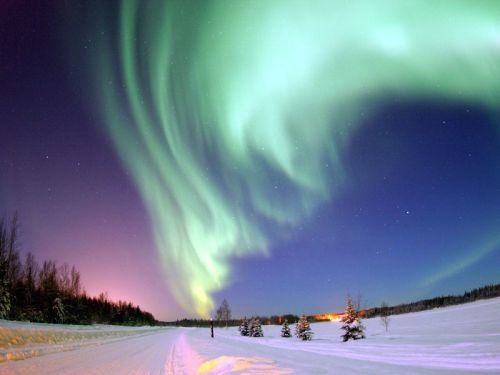
For centuries, folklore has reported that people have been able to hear, as well as see, the Northern Lights, or the aurora borealis. For the first time, researchers in Finland have been able to provide
evidence of what these historical listeners may have been detecting.

The "auroral sounds" are formed about 70 meters above the ground level, according to a team from Aalto University in Finland. They report that "researchers located the sound sources by installing three separate microphones in an observation site where the auroral sounds were recorded. They then compared sounds captured by the microphones and determined the location of the sound source. The aurora borealis was seen at the observation site. The simultaneous measurements of the geomagnetic disturbances, made by the Finnish Meteorological Institute, showed a typical pattern of the northern lights episodes."

Science Daily noted that: "Details about how the auroral sounds are created are still a mystery. The sounds do not occur regularly when the northern lights are seen. The recorded, unamplified sounds can be similar to crackles or muffled bangs which last for only a short period of time. Other people who have heard the auroral sounds have described them as distant noise and sputter. Because of these different descriptions, researchers suspect that there are several mechanisms behind the formation of these auroral sounds. These sounds are so soft that one has to listen very carefully to hear them and to distinguish them from the ambient noise."

Professor Unto Laine from Aalto University commented, "our research proved that, during the occurrence of the northern lights, people can hear natural auroral sounds related to what they see. In the past, researchers thought that the aurora borealis was too far away for people to hear the sounds it made. This is true. However, our research proves that the source of the sounds that are associated with the aurora borealis we see is likely caused by the same energetic particles from the sun that create the northern lights far away in the sky. These particles or the geomagnetic disturbance produced by them seem to create sound much closer to the ground."

Source: http://www.aalto.fi/en/current//news/view/2012-07-09/
Listen: http://www.youtube.com

Thursday, 10 November 2011

20Hz by Semiconductor


One of the works commissioned for the Invisible Fields: Geographies of Radio Waves exhibition in Barcelona was 20 Hz, an amazing new piece by Brighton-based artists and filmmakers, Semiconductor.

Semiconductor were commissioned to make a piece which showed us the relationship between radio waves and sound. The resulting work - 20 Hz - is an astonishing 5 minute video which uses data collected by the CARISMA radio array. CARISMA (Canadian Array for Realtime Investigations of Magnetic Activity) is is an array of magnetometers which study the Earth’s magnetosphere. 20 Hz is an interpretation of a magnetic storm occurring in the Earth’s upper atmosphere. The CARISMA data – captured at the frequency of 20 Hertz – is interpreted as audio, allowing us to hear the “tweets” and “rumbles” caused by the interaction of solar wind with the Earth’s magnetosphere. The visual element of the film is generated directly by the sound. Tangible and sculptural forms emerge suggestive of scientific visualisations. As different frequencies interact both visually and aurally, complex patterns emerge to create interference phenomena that probe the limits of our perception.

You can watch it at the artists’ website here.

Invisible Fields: Geographies of Radio Waves is a show that explores how our understanding of our world and our cosmos has been transformed by the study of radio waves. It is showing at Arts Santa Mònica in Barcelona, from 14 October 2011 - 4 March 2012.


Source:
&

Sunday, 15 May 2011

Sail to The Moon


In one of the more poetic and outlandish stories this week, The Observer report that engineers are planning to build the first extraterrestrial boat.

They want to launch the craft towards Titan - Saturn's largest moon - and parachute it on to the Ligeia Mare, a sea of methane and ethane on its surface.

Robin McKie, Science Editor of The Observer writes, "the robot ship would sail around this extraterrestrial sea for several months, exploring its coastline and measuring the winds and waves that sweep its surface."

Professor John Zarnecki, of the Open University is one of the scientists working on the project. "Waves on Titan's seas will be far larger, but much slower, than on earthly oceans, according to our calculations. That suggests Titan is the best spot in the solar system for surfing."

The mission to Titan - the only moon in the solar system with a thick atmosphere, of nitrogen and methane - would be the first exploration of a sea beyond Earth and could provide evidence about the possible existence of complex organic chemicals, the precursors of life.

It is part of the proposed Titan Mare Explorer, or TiME project.

If TiME is selected from a shortlist of three possible missions being considered for funding by NASA, McKie explains that "the TiME probe will be fired at Titan on a billion-mile journey across the solar system. Once it enters the moon's thick atmosphere the craft would parachute down towards the surface and then drop into the 300-mile-wide Ligeia Mare. It would then spend several months afloat on an oily sea taking measurements of waves, chemicals and other variables."

It follows on from the research undertaken by Cassini-Huygens. In 2005, the space-probe, Cassini deployed Huygens on the surface of Titan. Many of the instruments for that craft were built by Zarnecki and his Open University team, and that experience will put them in good stead for the TiME mission, should it go ahead.

Full story: http://www.guardian.co.uk

Source: Titan.pdf

&: SailtoThe Moon

Sunday, 26 September 2010

Cassini dives inside Saturn's radio aurora

NASA have produced stunning new images and video of Saturn's shimmering aurora. The images are helping scientists understand what drives some of the solar system's most impressive light shows.

Auroras happen when charged particles are funneled along converging magnetic field lines and into the upper atmosphere of a planet's poles. On Earth, aurora are caused mainly by the solar wind. But on Saturn a complex mixture of other geomagnetic phenomena appear to be involved. For instance, auroras can be caused by electromagnetic waves generated when the Saturn's moons move through the plasma that fills it's magnetosphere.

"Saturn's aurora are very complex and we are only just beginning to understand all the factors involved," said Dr Tom Stallard, from the University of Leicester, who presented some preliminary findings from the images at the European Planetary Science Congress in Rome.

Source: http://saturn.jpl.nasa.gov/news/cassinifeatures/feature20100923b/

Monday, 14 December 2009

Listening to the time-music of space

"He watched the sky, listening to the time-music of the quasars"
J.G. Ballard

The long-lost twin of the radio station Radio Astronomy has been found.

Space Weather links to the Air Force Space Surveillance Radar, which transmits a 216.98 MHz signal into the heavens 24 hours a day, 7 days a week. Meteors, satellites and spacecraft passing overhead reflect those signals back down to Earth. The radar's primary antenna is located near Lake Kickapoo, Texas. A few hundred miles away in Roswell, New Mexico, radio engineer and long-time spaceweather.com associate Stan Nelson picks up the echos using a yagi antenna on his roof. When a meteor or satellite passes over the facility, there is an whistling echo.

Source:
http://spaceweatherradio.com

Saturday, 28 November 2009

Saturn's auroras put on a dazzling show

Cassini has spotted the tallest known "northern lights" in the solar system, flickering in shape and brightness high above the ringed planet.

"The auroras have put on a dazzling show, shape-shifting rapidly and exposing curtains that we suspected were there, but hadn't seen on Saturn before," said Andrew Ingersoll of the California Institute of Technology in Pasadena, who is a member of the Cassini imaging team that processed the new video. "Seeing these things on another planet helps us understand them a little better when we see them on Earth."

Auroras occur on Earth, Jupiter, Saturn and a few other planets, and the new images will help scientists better understand how they are generated. Auroras appear mostly in the high latitudes near a planet's magnetic poles. When charged particles from the magnetosphere -- the magnetic bubble surrounding a planet -- plunge into the planet's upper atmosphere, they cause the atmosphere to glow. The curtain shapes show the paths that these charged particles take as they flow along the lines of the magnetic field between the magnetosphere and the uppermost part of the atmosphere.

Source:
http://www.sciencedaily.com/releases/2009/11/091125231252.htm

Monday, 23 November 2009

Rethinking Light and Sound

The director of the Census for Marine Life - Jesse Ausubel - rethinks how illumination and noise are rippling through ecosystems.
In his invited essay for Seed Magazine, he notes:

"When their generation looked up at the night sky a century ago, they saw swathes of stars. Today, however, our most familiar starry image may be satellites and astronauts looking down, observing the lights on Earth at night ...

I wonder if some of the changes experts attribute to carbon dioxide and global warming may owe more to nocturnal photons and their associates"

"... humans are adding about three decibels more sound to the ocean each decade, roughly doubling the power of the added noise. Because sound spreads widely in the oceans, human clamor touches every corner. ...As I wonder about life in a darker night, I wonder about marine life in a quieter ocean."

Source:
http://seed2.com/54295