Scientists and journalists from Huffington Post community have published a range of pieces on everything from data sonification, to astereoseismology, to the reminiscences of a former astronaut. Together these articles greatly expand the field of general knowledge around the physics of radio astronomy, and our capacity to sensorially experience it.
One of the pieces draws on an interview with radio astronomer, and the co-founder of the SETI Institute, Jill Tarter. Amplifying the central message ofTuning into the Universe, Tarter notes that:
"when SETI listens to the cosmos, the institute is actually receiving electromagnetic radiation. And then, just the way your radio does, that energy can be used to make audible sound."
The pieces published in response to the article extend, expand and ensonify this notion. Some of my favourites include:
The Sound of the Deep Sea of Space by radio astronomer, Dr. Tyler Nordgren equates the universe with a vast ocean, echoing Carl Sagan's famous analogy from his series, Cosmos. He poetically maps out the methods of astronomical observation available to modern astronomers, beyond the detection of visible light. He notes: "as a young radio astronomer I learned early on that every time human beings have explored the world with new senses we have discovered new and amazing phenomena".
Voices Carry by Anna Leahy and Douglas Dechow explores the sonic signature of our own planet:
"The sound of the Earth's inherent dynamics -- the movement of atmosphere and oceans -- produces a steady drone as well. Lightning produces crackling, which scientists call sferics."
Voyager Golden Record
The article includes a memorable passage about the Voyager Golden Record, which contains 'greetings in 56 languages, natural sounds like thunder and crickets chirping, and music from around the world', encoded in audio and now travelling towards the outer reaches of our solar system on board Voyager.
InAn Audible Tour of the Solar System? Sign Me Up!, astronomer and planetary scientist, Jim Bell analyses our celestial neighbourhood, exploring the potential for acoustic sound on each of our nearest planets. The Perfect Quiet of Space by legendary astronaut, Jerry L. Ross, is the extraordinary account of his nine spacewalks, undertaken during his seven missions into space.
Jerry L. Ross n one of his nine spacewalks.
He writes eloquently about the silence which astronauts experience, when outside the International Space Station:
"Without the sophisticated listening devices scientists use on earth to hear the whispers of the universe, to an astronaut space is infinite quiet, a place where we bring the only sounds that break the silence."
Sound: The Music of the Universe by Mark Ballora and George Smoot III is an excellent overview of the practice of data sonification, which takes in in the brilliant work of the xSonify team, who are making sonification applications for blind scientists. The article also refers to the emerging science of astereoseismology and exoseismology, which I talked about last Friday in my Sonic Acts talk.
They clearly explain why data sonification methods can be useful:
"Symbolic renderings create other perspectives. Literal renderings are not always compatible with the capabilities of our auditory system. When data points are treated as audio samples and played back at audio rates (typically at 44100 values/second) quick changes are lost to us, as we can't hear fluctuations discretely at the millisecond level. If, instead, we treat the data points symbolically, for example as pitches, we are better able to "magnify" what we are listening to."
InUnderstanding the Sound of Space, Ayodele Faiyetole notes that sound is under used in science. He draws on an interview with cosmologist, Yuko Takahashi, who believes there's a great value in presenting scientific results in a totally different dimensions, such as sound:
"Maps of CMB anisotropy can be converted to sound as a telescope sweeps across the sky to give the audience a better appreciation of the fluctuations."
As Ballora and Smoot put it, "if the universe is, at some level, music, then it seems only natural that we should study it with musical tools of thinking."
Sea above, sky below. The phrase is seemingly a contradiction and a mental paradox. Yet recent research into cosmology, astronomy and oceanography suggests that this riddle is perhaps not as irreconcilable as what it may first appear. Recalling Milton's evocation of the empty heavens as a kind of ocean, the inversion of sea and sky is taking place all around us, in physics and in oceanography.
The most important advances in scientific thought about the origins and structure of the universe now suggest that our world may be just one amongst many, floating in a cosmological sea. The space probe Cassini has revealed that even in the heavens above, oceans may in fact, be commonplace. Radio astronomers describe the noise storms of Jupiter and its moon Io as sounding like ocean waves breaking up on the beach. And here on the firmament we are increasingly turning to the oceans in order to better understand the skies.
After recently watching the documentary, Seeing Stars, which analyses the new generation of telescopes that enable scientists and engineers to do 'extreme astronomy', I was prompted to revisit some of the unusual techniques which are currently being used to probe the edges of our universe, which I first starting looking into a few years ago.
The documentary, by the way, is well worth watching:
The infant branch of astronomy, known as "neutrino astronomy" is motivated by the possibility of observing phenomena, such as cosmic neutrinos, that are inaccessible to optical telescopes. Cosmic neutrinos, which are believed to be produced by cosmic rays, are very difficult to detect. By building arrays deep under water, astronomers can make sure that most of the particles they detect are actually produced by cosmic sources. These detectors look down through the Earth to see the universe, using the whole planet as a shield to absorb the riffraff of particles from the atmosphere.
One of the leading voices within oceanic neutrino science is Dr Paschal Coyle (pictured), who is based in Marseille in France. His 2007 Journal of Physics paper, Neutrinos Out of the (Deep) Blue remains a valuable reference in surveying the various approaches to underwater neutrino observation.
He is a key researcher with the ANTARES observatory, which is situated under the Mediterranean Sea, 42km off the coast of Toulon. His team set out to monitor their below-sea telescope in the brilliantly named research vessel, Pourquoi Pas?.
ANTARES research vessel, Pourquois Pas?
ANTARES stands for "Astronomy with a Neutrino Telescope and Abyss environmental RESeach project", a rather clunkily assembled acronym, but one that figuratively at least, situates one of our most charismatic stars - Antares - deep under the sea.
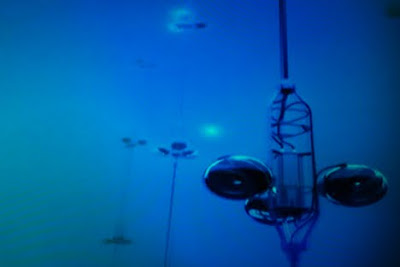
The ANTARES detector comprises a total of 900 optical modules distributed over 12 flexible lines, each comprising 25 storeys. They are anchored at the bottom of the sea at a depth of about 2.5 km, approximately 70 meters apart from each other.
Design visualisation of the ANTARES underwater detector modules
ANTARES is designed to detect neutrinos from space, coming from the direction of the Southern Hemisphere of Earth. As neutrinos have no mass and no charge, they fly through matter as if it wasn't there, and are therefore fiendishly difficult to detect. If a cosmic neutrino collided with Earth in the Southern Hemisphere, say for example in Australia, it would fly through the Earth and exit through the Mediterranean sea off southern France on it's way back out to space. ANTARES is constructed with the specific intention of detecting those elusive neutrinos on their ghostly and perpetual journey. Occasionally, on its journey, a muon neutrino will interact with the water in the Mediterranean. When this happens, it will produce a high energy muon.
ANTARES works by detecting Cherenkov radiation (pictured) emitted as the muon passes through the water. So ANTARES is a highly sensitive optical instrument designed to detect the uncanny blue glow of Cherenkov radiation caused by one of the rarest phenomena in existence.
Over the past four years, Paschal Coyle and his team, have made many expeditions to the underwater detector hunting for neutrinos. Whilst they have detected many neutrinos - consistent with what might be found in the Earth's atmosphere at any one time - they haven't found a single cosmic neutrino.
To put it more formally, as the team did in their May 2012 abstract, "no significant neutrino signal in excess of that expected from atmospheric background has been found". The team submitted a further paper to the Astrophysical Journal in July, and in it they emphasised, "no statistically significant signal has been found and upper limits on the neutrino flux have been obtained."
Despite this, the search goes on, and ANTARES has more than one function. As well as looking for particles of cosmic origin, and thus being an important part of the astrophysics community, ANTARES is also at the forefront of particle physics research, taking part in the search for dark matter. It complements the dark matter searches performed by experiments such as Fermilab's CDMS, and at CERN's dark matter work at the LHC.
ANTARES instrument panel aboard Pourquois Pas?
ANTARES' contribution to the field is to attempt to detect a hypothetical phenomena known as "neutralino annihilation", which is thought to take place in the Sun, or the centre of our galaxy. The theoretical particle, the neutralino, is considered a good candidate for the substance of the universe's cold dark matter. To confirm its existence, neutrino telescopes, such as ANTARES, look for evidence of the annihilation of neutralinos in regions of high dark matter density such as the centres of stars or galaxies. If ANTARES was able to detect this speculative phenomena, it would be a major breakthrough in our understanding of the universe.
As Edwards tells it, "whilst recording some drums in an old brick warehouse for the up and coming Eastern album we experienced a large aftershock. (5.8 in magnitude). We sat outside for a while and convinced ourselves it was ok to re enter the old building and continue our project... I was rolling as we were undertaking some line and level checking... this time we got it. 6.0 magnitude in a room full of kegs and bottles."
It's an incredible and sobering listen, and helps you understand what it must be like living in Christchurch - a city that's experienced nearly 10,000 earthqukes since the big one in September 2010.
Continuing our theme of sonification, particle physicist Matt Bellis is one of a group of scientists who have created a novel way of transforming particle detectors into musical instruments. The Particle Physics Windchime is a computer application that takes particle physics data, such as particle type, momentum, distance from a fixed point, and other datasets, and turns it into sound. First conceived at the Science Hack Day in San Francisco in 2010 by Bellis and fellow scientist, David Harris, the Windchime is currently sonifying data from BABAR, a high energy physics experiment located at SLAC National Accelerator Laboratory in California.
In creating their instrument, Bellis and his collaborators were inspired by the way that wind chimes work. Their chime is played by the particles passing through it, just like wind through a wind chime. "Think of it," Bellis said in a recent interview with SLAC, "the wind itself makes no sound. You hear the wind if it rustles the leaves in a tree. The motion of the wind itself doesn't necessarily make a sound. The wind has to interact with something to make noise." In the same way, "When you have these particles that pass through the detector, they send it ringing, resonating."
Bellis emphasises that sonifying data in this way can help lead to important new scientific insights: "I wanted to create the Particle Physics Windchime partly because I wanted to see if there's something new we can learn from the data. Is there something I can hear in the data that I can't see or that a computer can't pick up? Will it add to an intuitive understanding of the data?"
The Particle Physics Windchime is by no means the only project that sonifies particle physics data in order to understand it in new ways. The LHC Sound Project has been converting data from the ATLAS experiment at CERN for the last two years.
Run by Lily Asquith, Richard Dobson, Archer Endrich and Alabama 3 percussionist, Sir Eddie Real, the project is helping scientists see data from the LHC in different ways. The scientists and composers have notes in several interviews how musical the data appears to be:
"We can hear clear structures in the sound, almost as if they had been composed. They seem to tell a little story all to themselves. They're so dynamic and shifting all the time, it does sound like a lot of the music that you hear in contemporary composition," Richard Dobson (in an interview with the BBC, June 2010).
Our Particle Decelerator correspondent gives a TED talk on the story of the history of the universe by listening. It's punctuated by three anecdotes which show how accidental encounters with strange noises, taught us some of the most important things we know about space ...
Whilst the talk refers to "sounds from space", it is important to emphasise that stars and planets are not directly audible. Sound waves can not propagate in the vacuum of space. However, it is possible for radio waves emitted from celestial bodies to be heard by using radio technology.
The talk recalls the early history of the science of radio astronomy. Before astronomy was computerised, radio astronomers would monitor radio telescopes by listening. In our solar system, the Sun is the strongest source of radio waves, so it's the most powerful transmitter in our radio sky. Jupiter also sends us strong, and beautifully varied, radio signals. And radio astronomers also detect radio waves from far-flung celestial bodies in the distant universe, and simple audification techniques allow us to hear these signals.
This week, the remarkable Kepler spacecraft has been in the news for the fascinating new research it is generating in detecting the size and age of stars. Kepler is using a technique that scientists dub "asteroseismology" to measure minuscule variations in a star's brightness that occur as sound-waves bounce within it.
Dr Bill Chaplin, Reader in Solar and Stellar Physics, from the University of Birmingham's School of Physics and Astronomy, spoke at the American Association for the Advancement of Science conference on Saturday 19 February 2011, giving an overview of results on the study of solar-type stars using the science of asteroseismology.
Asteroseismology is the observation of the natural resonances, or pulsations, of stars. Using the data from these oscillations, collected by the NASA Kepler spacecraft, it is possible to measure the ages and sizes of stars, and to map out their interiors with hitherto unknown precision. The Kepler Mission is primarily used to look for extrasolar planets - planets that are outside our solar system orbiting other stars, but this new finding is one of the most significant pieces of research is has yielded in recent times.
Chaplin told the conference that asteroseismology was, in essence, listening to the "music of the stars" - a somewhat poetically apt reference, given that the Kepler craft is named after the 17th century German mathematician and astronomer, Johannes Kepler who reinvigorated Pythagorus notion of the"music of the spheres".
Last year, we reported on research published in Nature that showed how marine biologists were working hand-in-hand with physicists to use bio-acoustics technology for the dual purpose of monitoring marine live, and searching for neutrinos.
The recently launched Listening to the Deep Ocean Environment (LIDO) website takes this collaborative approach one step further. Michel André, a bioacoustician at the Technical University of Catalonia in Barcelona, Spain, and his colleagues, have spent the past 10 years placing hydrophones on the seabed, on existing research platforms that monitor earthquakes, tsunamis and detect neutrino particles from space.
They are studying sub-sea noise so that researchers can better understand the effects of human activity on whales and dolphins. But what's really extraordinary about their work is that they're allowing us to tune in. The LIDO website has links to live audio feeds from eleven hydrophones located in European waters, and North American waters.
André, quoted in the New Scientist, notes: "the system is powered from the shore, and streams audio data to a server where the signals are analysed and published directly on the internet."
With more hydrophones in the network the new system could reveal the effects of noise pollution on whales. Hydrophones can pick up sounds from baleen whales hundreds of kilometres away, so installations in different places could be used to triangulate an animal's position and track its course. It should therefore be possible to determine if animals change course in response to bursts of noise, or alter their preferred routes because of new sources of noise like shipping routes or harbours.
"It's the first time we have been able to monitor acoustic events on a large temporal and spatial scale," André says
An algorithm developed by André's laboratory filters the different frequencies in the signal to identify specific sounds, including the songs of 26 species of whales and dolphins, and noise from human activities such as shipping, wind farms, oil and gas drilling, and seismic testing.
Roger Gentry, an adviser for the E&P Sound and Marine Life Joint Industry Programme, comments that, "[Michel] André deserves a lot of credit for thinking in broad terms and using modern technology to make the oceans and marine mammals more familiar and accessible to us all."
André is a previous Rolex award-winner, acknowledged for his work designing a system to protect whales from collisions with ships: http://rolexawards.com/en/the-laureates/michelandre-biography.jsp
Musician Tony Conrad is quoted as saying, "modern physics had been generated as a branch of music" (http://bit.ly/fBUSe). New research carried out by the University of Twente seems to bear this out, with engineers and physicists creating the world's smallest musical instrument.
The micronium is the first musical instrument with dimensions measured in mere micrometres that produces audible tones. It has strings a fraction of the thickness of a human hair, with microscopic weights to pluck them: A composition has been specially written for the instrument by Arvid Jense, who is studying MediaMusic at the conservatorium in Enschede.
Science Daily notes that earlier musical instruments with these minimal dimensions only produced tones that are inaudible to humans. But thanks to ingenious construction techniques, students from the MESA+ Institute for Nanotechnology of the University of Twente in The Netherlands have succeeded in producing scales that are audible when amplified. To do so, they made use of the possibilities offered by micromechanics: the construction of moving structures with dimensions measured in micrometres. These miniscule devices can be built thanks to the ultra-clean conditions in a 'clean room', and the advanced etching techniques that are possible there.
The micronium played a leading role at the opening of a two-day scientific conference on micromechanics at Atak (http://www.atak.nl) in Enschede in September, where Arvid Jense's composition,'Impromptu No. 1 for Micronium', was premiered.
The tiny musical instrument is made up of springs that are only a tenth of the thickness of a human hair, and vary in length from a half to a whole millimetre. A mass of a few dozen micrograms is hung from these springs. The mass is set in motion by so-called 'comb drives': miniature combs that fit together precisely and shift in relation to each other, so 'plucking' the springs and creating sounds. The mass vibrates with a maximum deflection of just a few micrometres. This minimal movement can be accurately measured, and produces a tone. Each tone has its own mass spring system, and six tones fit on a microchip. By combining a number of chips, a wider range of tones can be achieved.
"The tuning process turned out to be the greatest challenge," says Johan Engelen, who devised and led the project.
The Guild of Scientific Troubadours is an alliance of songwriters united to write and record catchy pop songs about scientific discoveries. Nearly every day, a new discovery is revealed. Every week, new science art. Their website not only collects together precious flotsam and jetsam jettisoned from assorted science blogs and RSS feeds, but also acts as a repository for the musical tributes, which obviously, vary dramatically in quality.
Tony Conrad is the maestro of "extended duration as a conceptual armature", a musician, filmmaker and media-theorist of pioneering stature. He established the monochrome flicker as one of the central tropes in moving image, and created entirely distinctive forms of drone music both within, and outside of, The Dream Syndicate. In later works, such as Slapping Pythagoras his theoretical positions on Western cultural discourse became more evident.
"modern physics [has] been generated as a branch of music",
audiences:
"Something that intrigues me a lot – and which I still haven’t decided about – is the suggestion that music should not have audiences. Just to get the audience out of the picture entirely seems like an interesting challenge, because every time I tell myself that the audience is why I’m doing everything [....] Every time I find myself thinking that, I realize that I’m barking up the wrong tree, and that if I try to head in the opposite direction, there’s something like a multifarious void out there."
and the future:
"For me, there’s another project, and that is to begin to try to create a structure of laws that can address the needs of 2010. From Futurism to Dogme, manifesto-like conditions can be productive [...] There’s a kind of cultural convergence that’s taking place that brings all these things together. I don’t think that’s unproductive. It reflects the conceptual initiative that was apparent last century with Happenings and all kind of things, basically going back to the Futurists. The Futurists actually predicted the future."
Take a look at the trailer for this documentary about German sound alchemist, Trimpin.
He designs, builds, programs, and composes outrageous ensembles of musical instruments from the periphery of reality. One of his more ambitious experiments is designing a 'perpetual motion' machine in a glass foundry.
Before the radio, there was the Telharmonium, designed to broadcast music across the telephone wires. Here's a great link to one of our favourite archaic oddities, from our friends at Odd Instrument.
Lines of Flight is a festival of experimental music and film happening as part of this year's Dunedin Fringe Festival in New Zealand. Featuring the Dead C., Sandoz Lab Technicians, Crude, Eye, Rachel Shearer, Guy Treadgold, Sean O'Reilly, Dean Roberts) & more.
The "Dirt Beneath the Daydream" CD - distributed with The Wire magazine - features 21 tracks of prime New Zealand noise, avant rock, psych-folk, electronica, sound art, Improv and beyond.
Sincronie is a festival which takes place in Milan each year. In 2008 the festival focuses on astronomy. On Saturday 15 November 2008, a concert dedicated to the science of radio astronomy will take place .
It includes a performance by r a d i o q u a l i a, who will premiere the new work "SKR", and Italian musician, TeZ, who will perform a newly adapted version of his piece, "reSUNance", which premiered at Ars Electronica 2008.
The artists will also present a collaborative performance using sonified signals from astronomical sources.
Dark Designs will explore the notion of art, technology and conspiracies in a series of events taking place in venues across Yverdon-les-Bains in Switzerland.
Organised by Maison d’Ailleurs, the museum of Science Fiction, Utopia and Extraordinary Journeys, and the University of Art and Design in Geneva (HEAD), Dark Designs includes a symposium featuring acclaimed science fiction writer, Norman Spinrad, director of transmediale, Stephen Kovats, philosophers Pierre Lagrange and Daniel Pinkas, scientists Herbert Keppner and Jérôme Charmet, and many others. Dark Designs also includes an exhibition of digital art by students, located in Yverdon-les-Bains’ historic 13th century Savoyard castle, and an evening of extraordinary performances by artists Evelina Domnitch & Dmitry Gelfand and Gaspard Buma, hosted by the picturesque theatre, L’Echandole, situated in the caves of the castle.
Particle Decelerator collects together particles of news and information about the worlds of science, art and technology, placing a special emphasis on the collision between the quantum and the cosmological. It aims to slows down particles of data in order to grasp them more coherently.
Most posts are by Honor Harger.
It is part of the Nature Blogging Network: http://blogs.nature.com
Email us at: particle.decelerator@gmail.com